Collectively-unlockable knowledge
Lockbox
What if publishing was a multiplayer game?
Content stays encrypted until enough people contribute to unlock it. Not a paywall. A coordination mechanism.
What if publishing was a multiplayer game?
Content stays encrypted until enough people contribute to unlock it. Not a paywall. A coordination mechanism.
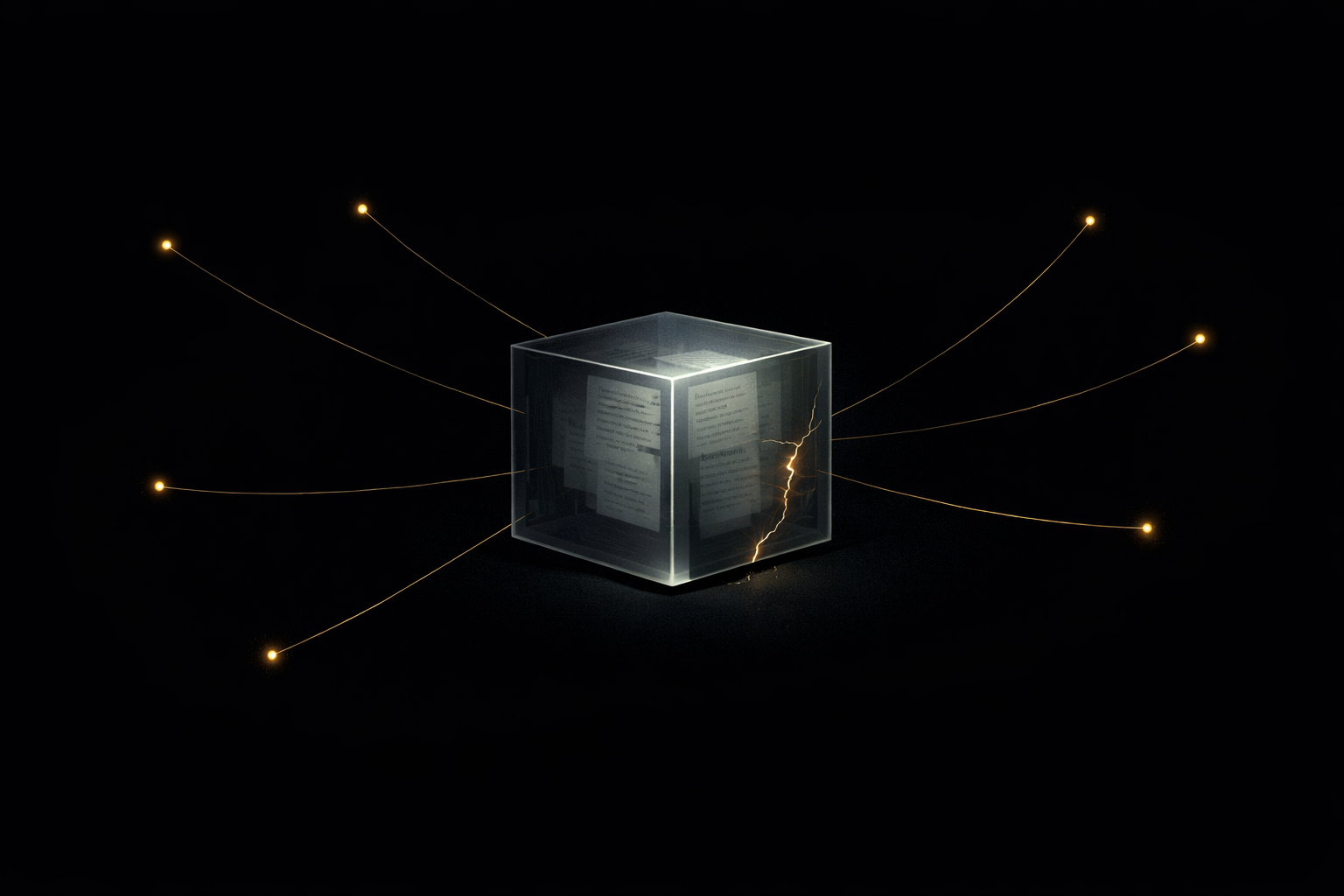
A lockbox holds encrypted content—an article, a research paper, a dataset, a course. It’s published openly, with its title, abstract, and metadata visible to anyone. But the content itself is sealed. Not behind a paywall owned by one company. Behind a threshold owned by everyone.
To open it, a set number of people must each contribute a small amount. Not one buyer paying $50. Ten people paying $5. Or a hundred paying fifty cents. The economics shift from individual purchase to collective investment.

Knowledge has network effects. The more people who understand something, the more valuable that understanding becomes—to each of them, and to everyone around them. A paper on climate modeling is more useful when a hundred researchers have read it than when one has. A security audit is more valuable when every developer on the project can reference it. Knowledge compounds when it circulates.
But the way we pay for knowledge treats it as an atomistic, solitary act. One reader, one paywall, one transaction. This model made sense when distribution was physical—when a book had to be printed and shipped to your door. It makes no sense when distribution is free and the marginal cost of another reader is zero.
The existing alternatives are all compromised. Paywalls isolate—they work by exclusion, and the people who most need access are often the ones who can least afford it. Advertising corrupts—it optimizes for attention, not understanding, and slowly bends every publication toward engagement bait. Free devalues—when everything is free, nothing is funded, and the people creating knowledge subsidize the people consuming it through unpaid labor and institutional prestige that substitutes for revenue.
Lockbox proposes a different primitive. Not a paywall. Not a tip jar. A coordination mechanism. The content exists. It is already written, already encrypted, already stored. The only question is whether enough people want it unlocked. If they do, they fund it collectively. If they don’t, no one is worse off—no one paid for something that didn’t reach its audience.
The progress bar is not a feature. It is the mechanism’s marketing. Every contribution moves it forward, and every increment is visible proof that other people found this worth funding. Social proof is not bolted on as a testimonial or a star rating. It is baked into the economics. You don’t have to trust a publisher’s claim that the content is good. You can see that fourteen people have already put money toward finding out.
Post-unlock, the content becomes a public good. Not a purchase that sits in one person’s library. A thing that was collectively funded and is now collectively accessible. The contributors didn’t buy a product. They funded something the world gets. There is a meaningful difference between those two acts, and Lockbox is built on that difference.
Then there is the agent era. Machines increasingly need to access, evaluate, and act on knowledge. They need to do so with verifiable identity, auditable spending, and privacy guarantees. ERC-8004 gives agents identity. Reputation receipts give them trust. Threshold encryption gives them the assurance that access control is not dependent on a single custodian who can revoke it. This is not an afterthought—it is the second half of the same thesis. If knowledge has network effects among humans, it has network effects among machines too.
The future we are building toward is a web where knowledge is collectively funded and universally accessible after unlock. Where the act of paying for information is a collective investment, not an individual expense. Where the progress bar replaces the paywall. And where both humans and autonomous agents can participate in the same coordination game—each contribution a verifiable, on-chain receipt that says: I thought this was worth knowing.
A live lockbox deployed on-chain. Connect a wallet, contribute, watch the threshold move.